What is Geometric Tattooing?
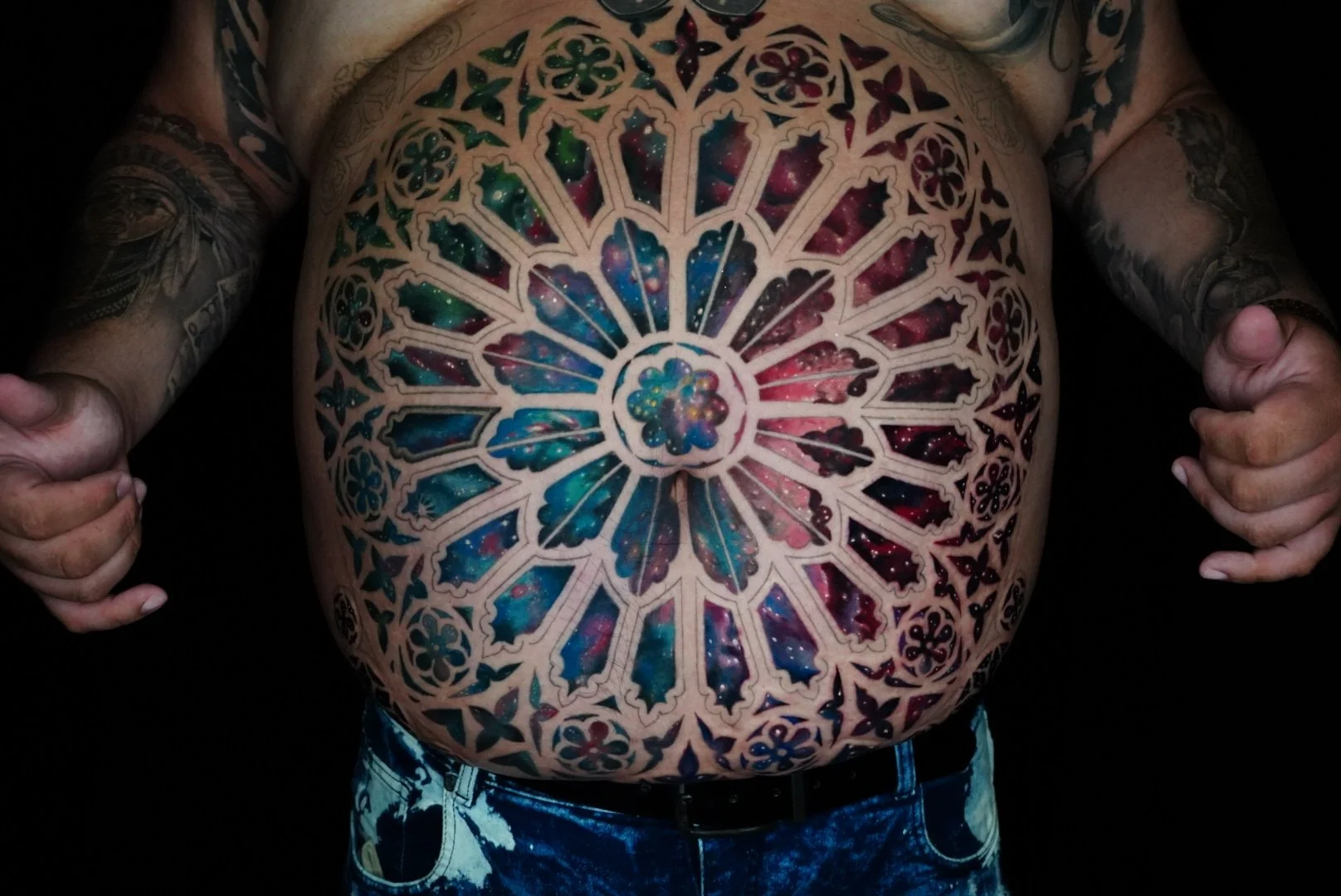
Geometric tattoos are built on the absolute foundation of perfect symmetry, repeating patterns, and precise linework. Unlike realism, which mimics a photograph, geometric work relies on mathematics and structure. It uses fundamental shapes—circles, triangles, hexagons, and intricate dot-work—to build complex optical illusions.
The Cultural Origins of Geometric Art
Geometric patterns are some of the oldest forms of human expression. Long before we were tattooing realistic portraits, humans were marking the skin with structured lines and shapes. The geometry you see in modern tattooing pulls from several ancient traditions across the globe:
Sacred Geometry: This is the ancient belief that certain shapes and mathematical proportions are the architectural blueprints of the universe. Patterns like the "Flower of Life," the "Golden Ratio," or "Metatron's Cube" appear everywhere in nature, from the structure of a honeycomb to the spiral of a pinecone. In tattooing, sacred geometry represents harmony, balance, and a direct connection to the physical world.
Mandalas (Hinduism and Buddhism): Originating in ancient India, the mandala is a complex geometric design radiating outward from a single central point. Culturally, they are used as tools for meditation and represent the universe and the spiritual journey. On the skin, a mandala is often a symbol of inner peace, focus, and infinite balance.
Islamic and Moorish Architecture: Because traditional Islamic art often prohibits the depiction of human figures, their artists became the undisputed masters of geometric tessellations (repeating patterns with no gaps). The intricate, interlocking stars and polygons you see in heavy blackwork tattoos are directly inspired by the complex tile work found in centuries-old mosques and palaces.
Polynesian and Indigenous Origins: Many indigenous cultures use repeating geometric bands, triangles, and spearhead motifs to tell a visual story of lineage, strength, and protection. While modern geometric dot-work is a different technical style, the concept of using heavy, repeating shapes to map out and complement the body’s anatomy comes straight from these ancient tribal roots.
The Technical Reality of Geometric Tattoos
There is absolutely no hiding mistakes in a geometric tattoo. It is one of the most unforgiving styles in the entire industry.
Precision is Everything: If a single line is blown out or a dot-whip gradient isn't perfectly smooth, the entire illusion of symmetry is broken. It requires a completely steady hand and total technical control.
Body Flow and Anatomy: A flat geometric design printed on a piece of paper looks completely different when wrapped around a human arm or leg. The design has to be perfectly mapped to your specific anatomy so it doesn't warp or distort when you walk, bend, or move.
High Contrast Execution: To make these patterns pop, I use heavy, saturated black ink placed right next to negative skin space, smoothed out with meticulous dot-work shading. This gives the tattoo intense depth and makes the pattern look like it's carved into the skin, rather than just drawn on it.