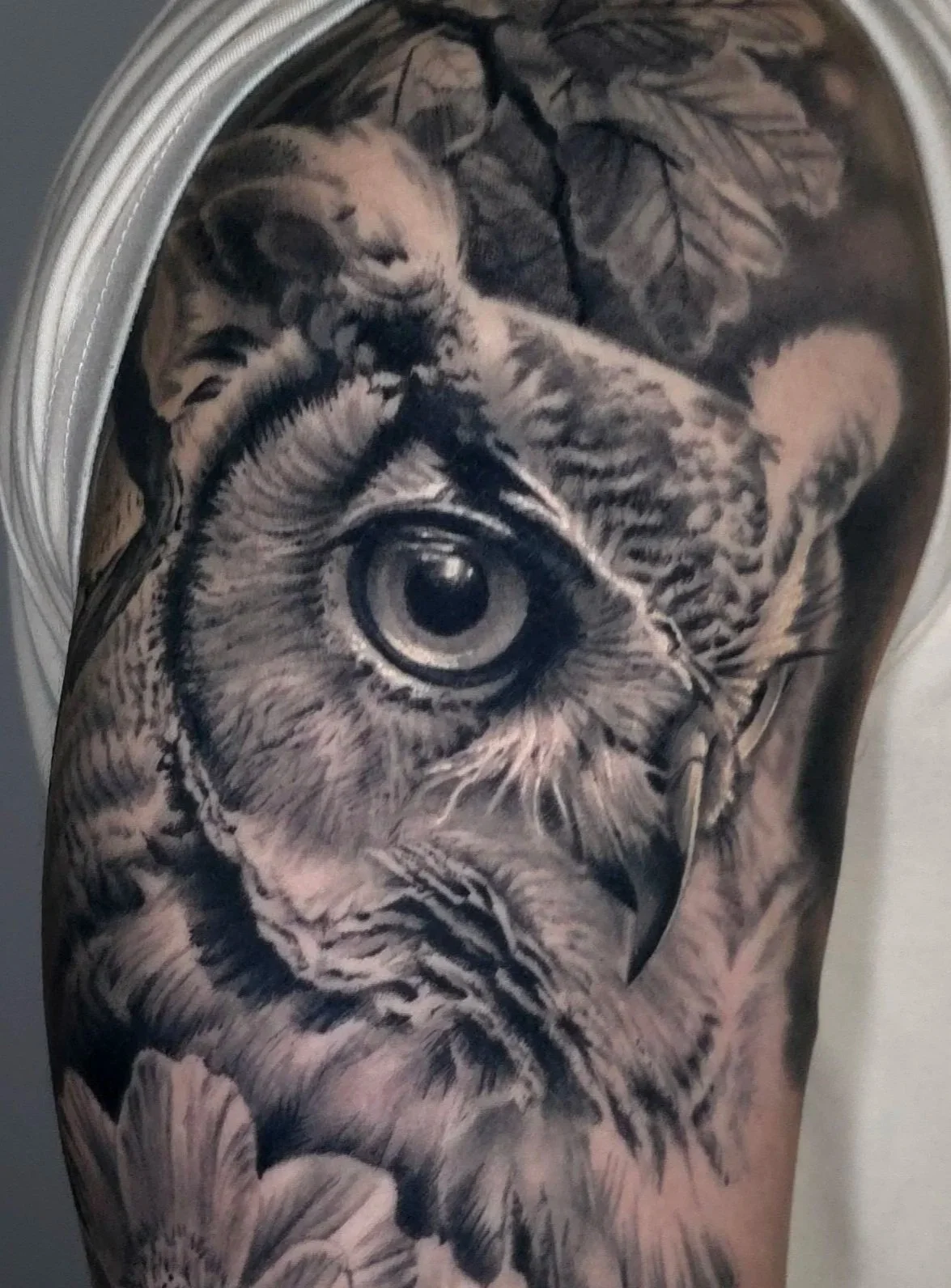
The Philosophy of High-Contrast Realism
Black and Grey Realism is the pinnacle of technical tattooing, focusing on depth, atmospheric contrast, and hyper-fine detail. Unlike traditional styles that rely on a "black outline" to hold the shape, realism uses varying shades of grey wash to build a three-dimensional effect directly on the skin. My approach at Black Atlas Studios is to treat every project as a piece of fine art, utilizing light and shadow to create a "breathing" composition that resembles a high-contrast photograph.
The Technical Standard: Grey Wash vs. Opaque Grey
In the studio, I utilize a specialized Grey Wash technique. This involves diluting professional-grade black ink into multiple gradations.
Why it matters: Grey wash heals into the skin with more transparency and "softness" than solid grey pigments, allowing for the smooth, pore-level detail found in Portraiture and Micro Realism.
Longevity: By prioritizing high-contrast "low-lights" (deep blacks) and strategic negative space (highlights), the tattoo is engineered to hold its structure and clarity for a lifetime, preventing the "muddy" look often seen in lower-quality realism.
Portraits vs. Realism: The Distinction
It is important to understand how these categories overlap for your custom project.
Portraiture: This is a subset of realism specifically capturing the likeness of a person or pet. It requires surgical precision in "mapping" facial features and capturing character.
General Realism: This covers a broader spectrum, including architectural statues, cinematic landscapes, wildlife, and Chrome/Metallic textures.
The Custom Edge: Every piece I design is a "Mixed Media" composition. I often integrate Geometric structures or Blackwork frames to contrast against the soft realism of the main subject, ensuring your tattoo is a unique, one-of-a-kind statement.
Reference Quality & The Design Process
The success of a hyper-realistic tattoo is 50% technical execution and 50% reference selection. I work closely with my Chicago clients to source high-resolution imagery with Directional Lighting.
Ideal Reference: Photos with a clear light source create the "hot spots" and deep shadows necessary for a 3D effect.
The Consultation: During our session at the Pilsen studio, we analyze the anatomical flow of the placement to ensure the design moves naturally with your body.